
How Should Streetwear Joggers Fit? Waist, Rise & Cuff Guide


Streetwear joggers should sit securely at the waist without pressure, leave enough room through the thigh for a full stride, and finish at the ankle with a small break rather than a stack of fabric. That is the short version of how should joggers fit. The longer version is that five areas decide the outcome: waist, rise, thigh, taper and cuff. Get one of them wrong and the others stop working, which is why going up a size rarely fixes a fit problem on its own. Here is what to check in each area, and how to judge it before you buy.
How Should Streetwear Joggers Fit?
Streetwear joggers fit correctly when the waistband stays in place without digging in, the seat and thighs allow a full stride, the rise keeps the crotch seam sitting naturally rather than pulling or hanging low, and the hem lands at or just above the top of the shoe. The leg should read as deliberate volume, not as fabric with nowhere to go.
Five things are being balanced at once: comfort, mobility, shape, proportion and controlled volume. The first two you can test in thirty seconds by sitting down and taking a long step. Shape and proportion only show up in a full-length mirror. Controlled volume is the one most people miss: a jogger can be roomy and still hold a clean line, but only if the extra room sits in the leg rather than the waist.
Start With the Waist
The waist is the anchor for everything below it. When a waistband slides, it changes the rise, the crotch position and the leg length at the same time, so a pair that fits well everywhere else can still look wrong by the afternoon.
A secure waist holds the joggers in place while you walk, sit and reach without you thinking about them. Most streetwear joggers use an elasticated waistband with a drawstring, which gives you a working range instead of one fixed measurement. The 10/10 Boys joggers are built that way, with an elasticated waist and an adjustable drawstring.
Too tight shows up as a mark left after an hour, a band that folds over on itself when you sit, or diagonal creases pulling from the waistband towards the hip. Too loose shows up as constant hitching, a drawstring tied hard enough to gather the front into a bunch, or a crotch sitting noticeably lower by the end of the day than it did in the morning.
If the waistband only works with the drawstring pulled to its limit, the size is wrong. A drawstring is there to fine-tune a fit, not to create one.
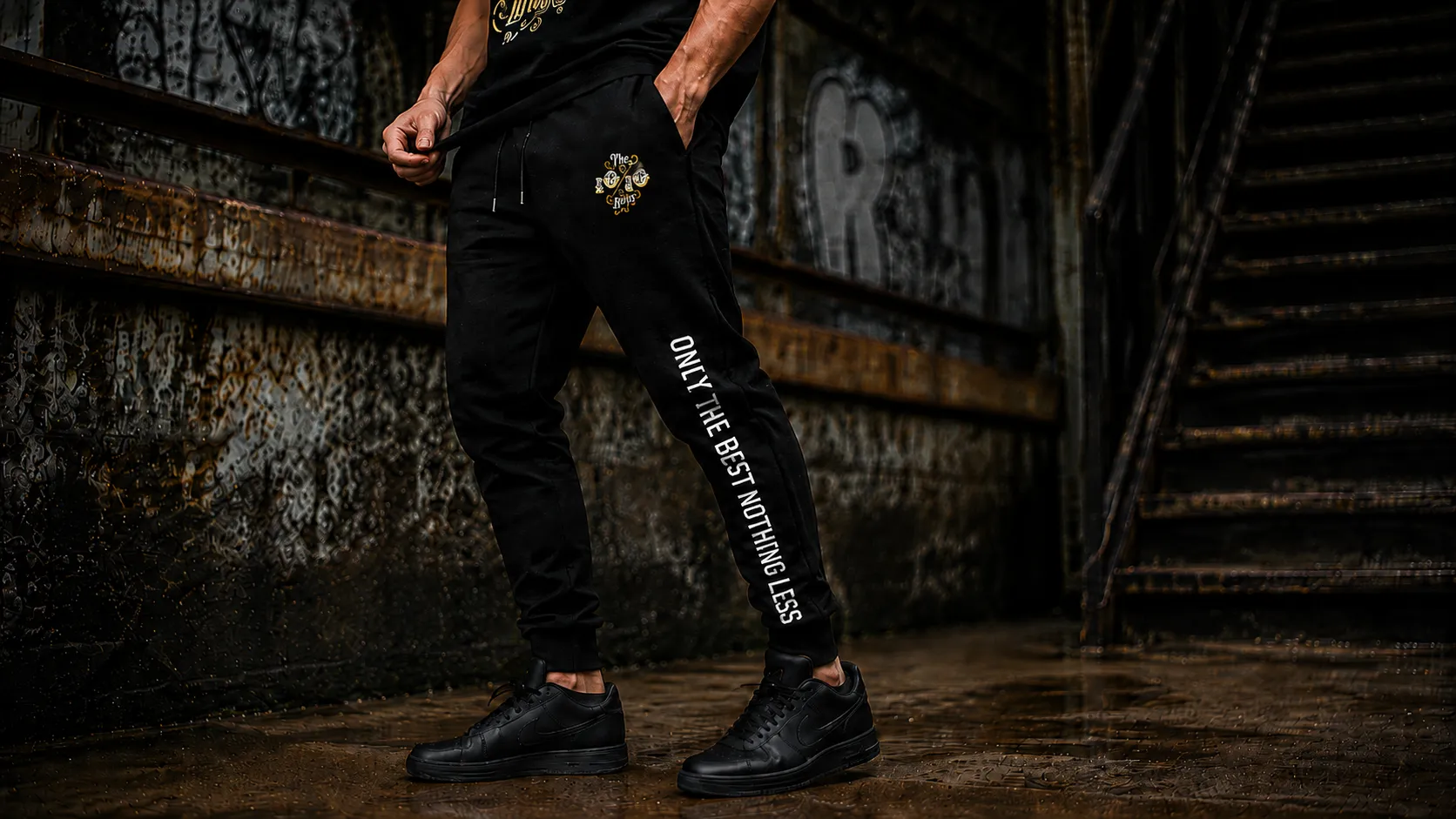
How Much Room Should Joggers Have Through the Thigh?
Through the thigh you want enough room to pinch a small amount of fabric on each side while standing, and enough that sitting down does not pull the material tight across the front of the leg. That is roughly where mobility and shape meet.
With too little room the joggers behave like trousers cut for a slimmer leg: the fabric strains when you sit, creases set into the thigh, and any print running down the leg distorts. With too much, the silhouette changes character. Extra volume high on the leg pushes the visual weight of the outfit towards the floor and shortens the leg line, which is the usual reason a pair feels off without an obvious fault.
Why the Rise Changes the Entire Fit
The rise is the distance from the crotch seam to the top of the waistband. It decides where the joggers sit on your body, and it affects proportion more than most people expect.
A rise that suits you puts the waistband where you actually want to wear it and leaves the crotch seam sitting close without pressure. Too short pulls the waistband down at the front and tightens everything through the seat. Too long drops the crotch seam towards the thigh, which shortens the visible leg and makes even a well-cut taper look heavy.
The test is quick. Stand normally, then lift one knee to hip height. If the waistband drops or the seat pulls sharply, the rise is short for you. If the crotch seam barely moves because there is slack sitting under it, the rise is long.
Tapered vs Relaxed Joggers
Taper describes how much the leg narrows between the knee and the ankle. It is the single decision that most affects how a pair reads from a distance.
| Fit | Leg shape | Visual effect | Best suited to |
|---|---|---|---|
| Tapered | Narrows noticeably between knee and ankle | Cleaner line, more structure, leg reads longer | Oversized tops, layered fits, low-profile footwear |
| Relaxed | Holds close to the same width down the leg | Softer, heavier silhouette with more movement | Fitted or mid-weight tops, bulkier footwear |
Neither is better as a rule. Tapered joggers hold their shape when the top half carries volume, which is why they sit well under an oversized tee or hoodie. Relaxed joggers put more weight at the bottom of the outfit, so they usually want a top with more structure to balance them. The Only The Best joggers use a relaxed tapered cut, which sits between the two: room through the thigh, then a leg that narrows towards the ankle.
Where Should Jogger Cuffs Sit?
The cuff should sit on or just above the top of the shoe, with at most one soft fold above it. That placement keeps the leg line unbroken and lets the footwear read as part of the outfit rather than something the trousers are covering.
Too long and the fabric stacks into several folds at the ankle, which shortens the leg and makes the pair look borrowed. Too short and the cuff sits high with a visible gap above the shoe, which reads as accidental unless the rest of the outfit is clearly built around it.
Footwear changes the answer. A bulkier trainer or a boot takes up height, so the same joggers stack more; a low-profile shoe leaves the cuff closer to the ankle. If you wear one type of footwear most of the time, judge the length in those shoes rather than barefoot.
How Oversized Joggers Should Fit
Oversized joggers are not simply two sizes up. Buying up adds volume everywhere, including the waist and the rise, and those are the two places extra room causes problems. The result is usually a pair that slides, drops the crotch and drags on the floor.
An oversized fit that works keeps four things under control:
- Waist security. The band still holds on its own, without the drawstring doing all the work.
- Intentional volume. The extra room sits through the thigh and the leg, where it creates shape.
- Controlled length. The hem still finishes near the top of the shoe rather than under it.
- Proportion. The volume relates to what you are wearing on top instead of competing with it.
If sizing up is the only way to get the leg volume you want, check the waist measurement first. A jogger with a genuinely relaxed leg cut in your usual size will almost always look better than a slimmer cut bought a size or two large.
How to Choose Your Jogger Size Online
Buying joggers online is mostly a measurement exercise. Size labels are not standardised between brands, so an M in one wardrobe can be an L in another.
- Start with the size guide, not the label. The joggers product page lists waist, hip, inseam, outseam and leg opening for every size from S to XXL.
- Compare against a pair you already own. Lay a jogger you like flat and measure the waist, inseam and leg opening. Those three numbers tell you more than any conversion chart.
- Decide the silhouette before the size. A clean line, a relaxed leg and a deliberately oversized look are three different targets, and they can point to different sizes in the same product.
- Read the garment-specific detail. Fabric weight, a brushed interior and elastic content all change how a jogger sits and how much it relaxes with wear.
- Check the inseam against your height. Leg length causes more online returns than waist size, and it is the measurement people skip.
The 10/10 Boys sizing guide covers how the rest of the range fits, including how tops size against the bottom half.
Quick Jogger Fit Checklist
| Area | What to look for | Sign the fit is wrong |
|---|---|---|
| Waist | Stays in place with the drawstring only lightly tied | Marks the skin, rolls over when seated, or needs constant adjusting |
| Thigh | A small amount of fabric to pinch on each side | Pulls tight when you sit, or adds bulk high on the leg |
| Rise | Crotch seam sits close without pressure | Waistband drops when you lift a knee, or the seam hangs at mid-thigh |
| Leg | Narrows gradually and hangs straight | Seams twisting round the leg, or a flare below the knee |
| Cuff | Sits on or just above the shoe, one soft fold at most | Several stacked folds, or a visible gap above the ankle |
| Length | Hem finishes near the top of your usual footwear | Fabric dragging on the floor, or riding up when you walk |
If five of the six are right and one is not, the problem is usually the size. If three or more are wrong, it is the cut, and a different size will not fix it.
FAQs About Jogger Fit
Should joggers be tight or loose?
Neither. Joggers should be secure at the waist and roomy enough through the thigh for a full stride, then narrow gradually towards the ankle. Tight through the seat restricts movement; loose everywhere removes the shape.
Where should joggers sit on the ankle?
On or just above the top of the shoe, with no more than one soft fold above the cuff. More stacking than that shortens the leg line, and a visible gap above the shoe reads as unintentional.
Should you size up for oversized joggers?
Only if the waist measurement still works. Sizing up adds volume to the waist and rise as well as the leg, which causes sliding and a dropped crotch. A relaxed cut in your usual size is the more reliable route.
How much room should joggers have around the thighs?
Enough to pinch a small amount of fabric on each side while standing, and enough that sitting down does not pull the material tight across the front of the leg.
How are streetwear joggers supposed to fit?
Secure at the waist, roomy through the thigh, with a rise that keeps the crotch seam sitting naturally and a hem that finishes near the top of the shoe. The volume is intentional and sits in the leg, not the waistband.
How should sweatpants fit?
The same principles apply. Sweatpants are usually cut in a heavier fabric with a wider leg opening, so they stack more at the ankle and depend on the waist being right even more than a tapered jogger does.
Fit Is the Standard
A pair that fits properly does the same job every time you put it on: holds at the waist, moves with you, and keeps a clean line from hip to hem. Once that is settled, colour, weight and how you build an outfit around it become choices rather than repairs. You can see how the current Bottoms collection is cut, and how it sits alongside the hoodies and t-shirts in the range.