
The 10/10 Boys Latest: Why Scarcity Only Matters When Quality Is Real


When people look for The 10/10 Boys latest, they are not always looking for just another product update.
Most of the time, they are looking for signal.
They want to know what is live, what is worth paying attention to, and whether the brand is actually building something with meaning behind it. In streetwear, that matters. Anyone can say a drop is limited. Anyone can create urgency. Anyone can try to make people rush.
That does not make it real.
Scarcity on its own means nothing when the product feels average, the quality does not hold up, and the identity behind the release is weak. A limited drop is only powerful when there is something strong enough underneath it to deserve the attention.
That is the difference between noise and presence.
That is also the difference between a brand that chases hype and a brand that builds its own lane.
Limited does not mean important by default
A lot of brands use scarcity as decoration.
They throw “limited” on a release, reduce the stock, add pressure, and expect that to create value by itself. But people feel the difference. They know when a drop is only trying to force urgency, and they know when a release actually carries weight.
Being hard to get is not the same as being worth having.
A real limited drop should feel intentional from every angle. The piece should look right. The fit should feel right. The quality should back the message. The release should make sense inside the wider world of the brand. Without that, scarcity becomes a shortcut, and shortcuts do not build loyalty.
They only create temporary attention.
Why quality is the first thing that has to be real
The strongest drops do not rely on pressure alone. They stand up even when the countdown disappears.
That is where quality changes everything.
In streetwear, quality is not just about fabric or construction, even though those things matter. It is also about confidence. It is about whether the piece holds its shape in real life. Whether it wears the way it should. Whether it still feels strong after the first impression is gone.
That is what people remember.
The truth is simple: scarcity might get someone to look once, but quality is what makes the drop stay in their mind. When the standard is real, the release carries itself differently. It feels considered. It feels sharper. It feels like it belongs to a brand with control, not a brand throwing products into the market and hoping one lands.
That is how a limited drop stops being a gimmick and starts becoming part of a brand code.
The 10/10 Boys latest should feel like a standard, not just a release
The phrase The 10/10 Boys latest should not only mean “new arrivals.”
It should mean the next expression of the brand.
That is more important than people think. The best brands do not treat every release like a separate event with no connection to the last one. They build continuity. Every new drop adds to the identity. Every release says something about the taste, the direction, and the world the brand is building around itself.
That is where scarcity starts to matter in a deeper way.
Not because there are fewer pieces.
Because there is more intention.
When a brand has a clear point of view, a limited drop feels curated. It feels controlled. It feels like access to something with shape and meaning. Without that, the same drop just feels like low stock and louder marketing.
Identity is what gives scarcity meaning
A drop should never live alone.
It needs a wider story around it. It needs a brand language people recognise. It needs consistency in how the pieces are designed, presented, and understood. Otherwise the release might create a quick spike, but it will not build memory.
That is why the identity side matters so much for The 10/10 Boys.
This is not only about clothing. It is about tone, direction, attitude, and community. It is about creating a brand people can read beyond a single item. When the identity is strong, the drop means more because it feels like part of something larger.
For that reason, this article works best when it sits next to About The 10/10 Boys. That page gives the deeper context behind the brand, and it helps explain why limited drops are not random here. They are part of a bigger way of building presence.
Scarcity without identity feels forced.
Scarcity with identity feels earned.
The product still has to do the talking
No brand story survives weak product.
That is the part too many labels try to skip.
You can have a strong visual world, a sharp message, and the right words around a drop, but if the piece does not hold up once people wear it, the illusion ends there. The strongest streetwear brands understand that the product still has to carry the final word.
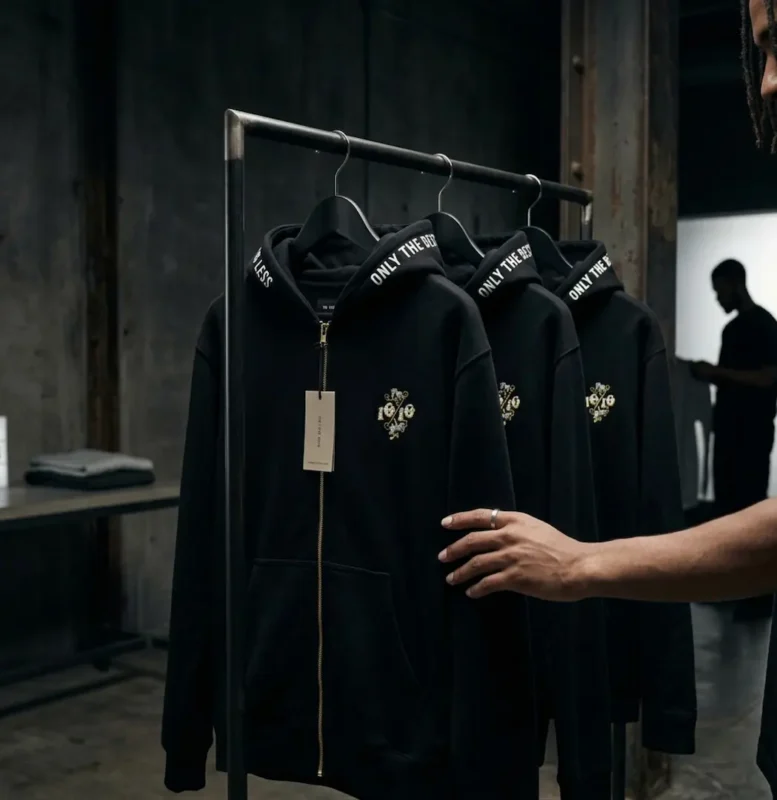
That is why a philosophy around limited drops only works when it connects back to the collection itself. Someone might arrive here through a brand search, then move into the latest pieces, check the shape of the hoodies, or browse the T-shirts.
That journey matters because it confirms whether the message is true.
If the article says the brand values quality, curation, and identity, the product pages need to make that feel obvious. Not exaggerated. Not overexplained. Just obvious.
That is when the brand starts to feel coherent.
Real scarcity comes after real standards
Limited drops are not powerful because they are limited.
They are powerful when people can feel that something was protected in the process. Taste. Quality. Direction. Consistency. Restraint. A standard.
That is what makes a release worth watching.
The brands that last are not the ones that create the most pressure. They are the ones that make people care before they even click through. The ones that know how to say less, release less, and still leave a stronger impression because what they do release actually means something.
So when people search for The 10/10 Boys latest, the goal should never be to show them something new just for the sake of it.
The goal is to show them something that still feels solid once the hype is stripped away.
Because in the end, scarcity is not the value.
It only reveals whether the value was there in the first place.
Round out the look — featured: Hoodie Los Angeles. Drop now live: latest spring drop.