
Winter Streetwear Accessories: What Actually Works Together

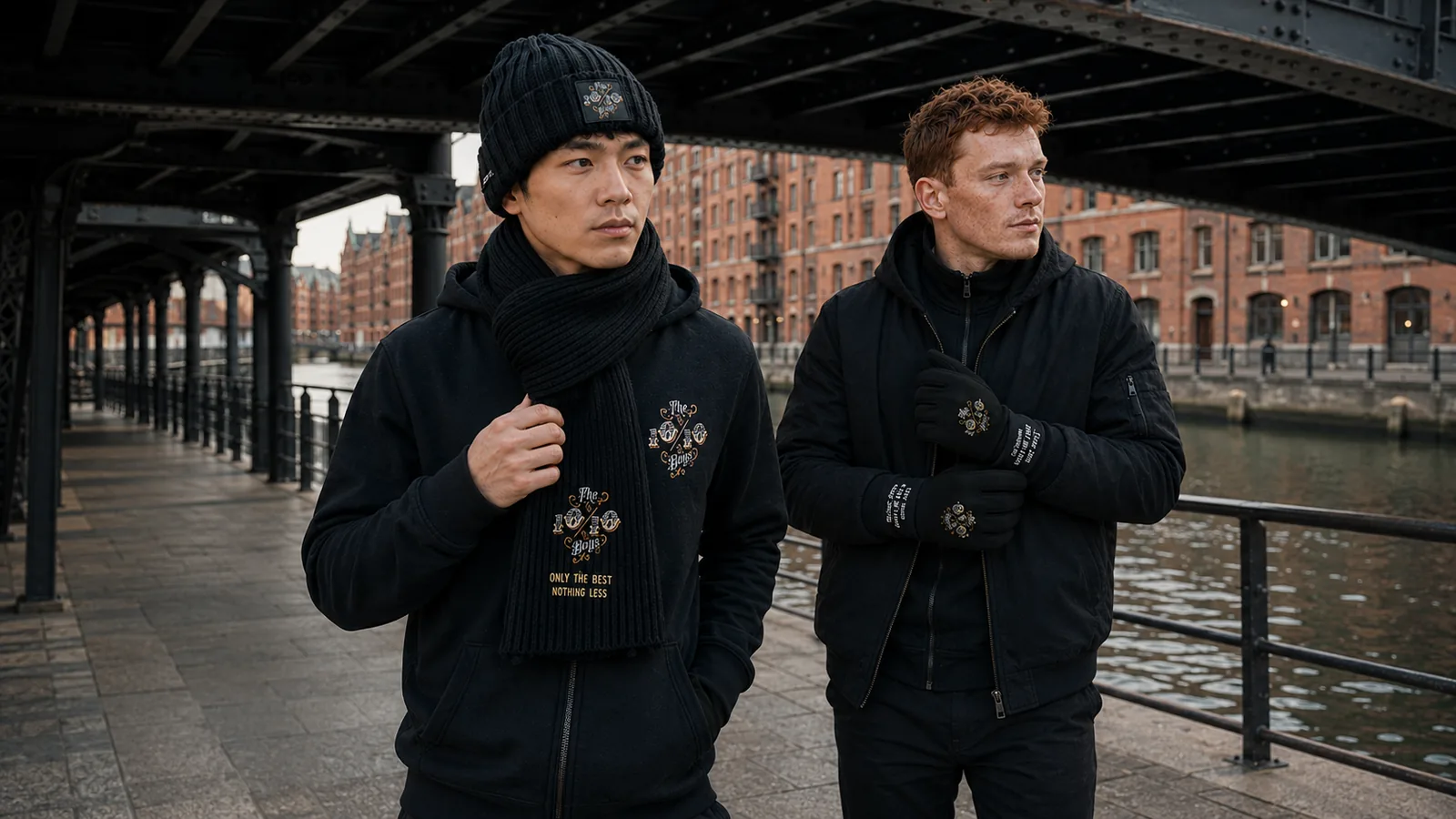
Winter streetwear accessories work together when every piece has one clear job and nothing competes for attention. A beanie, a scarf and gloves can each be strong alone and still collapse into noise worn all at once. The fix is a hierarchy: let one piece carry the look, and let the rest support it by repeating a tone or a texture. Proportion decides whether an outfit reads clean or heavy; colour and surface decide whether it reads considered or accidental.
What Makes Winter Streetwear Accessories Work Together?
Function. Each piece should solve something real: cold ears, an exposed neck, cold hands. Anything purely decorative is the first thing to feel like clutter by mid-afternoon.
Proportion. A beanie, a hood and a thick scarf all live within about thirty centimetres of each other, which is why the head and neck are where an outfit gets crowded fastest.
Colour. A tone repeated across two or three pieces reads as a decision; five unrelated shades read as an accident.
Texture. Ribbed knit, brushed fleece and a smooth shell catch light differently, which is what keeps an all-black outfit from going flat.
Most pieces worth building a rotation around sit in the The 10/10 Boys accessories range. The table below is how the main ones behave.
| Accessory | Practical role | Visual effect | Pairs well with | Avoid |
|---|---|---|---|---|
| Beanie | Covers head and ears | Frames the face, shortens the silhouette | A hood worn down, a clean neckline | A raised hood plus a thick scarf as well |
| Scarf | Closes the gap at the neck | Adds a vertical line and a block of texture | A plain chest, a zip hoodie, a low collar | Sitting it over a chest graphic |
| Gloves | Keeps hands warm and usable | Extends the sleeve, finishes the arm | Almost anything; they rarely compete | Bulk that stops you using a phone |
| Zip hoodie | Mid layer, or outer layer on milder days | Sets upper-body volume and hood size | A beanie with the hood down, gloves | Treating it as background when it carries the graphic |
Start With One Main Functional Accessory
Pick the piece that solves the biggest problem that day and build outwards; that decision settles what everything else is allowed to do.
If it is genuinely cold, a beanie is usually the anchor: it sits closest to the face, so it is read first. Give it the strongest branding and keep the rest plain. If the temperature is manageable but the outfit looks unfinished, a scarf anchors better, bringing more texture and a longer line. Gloves are rarely the anchor, which is why they are useful.
Building the rotation from scratch rather than styling what you own? The 10/10 winter starter pack covers which pieces to buy first.
How Beanies and Hoodies Work Together
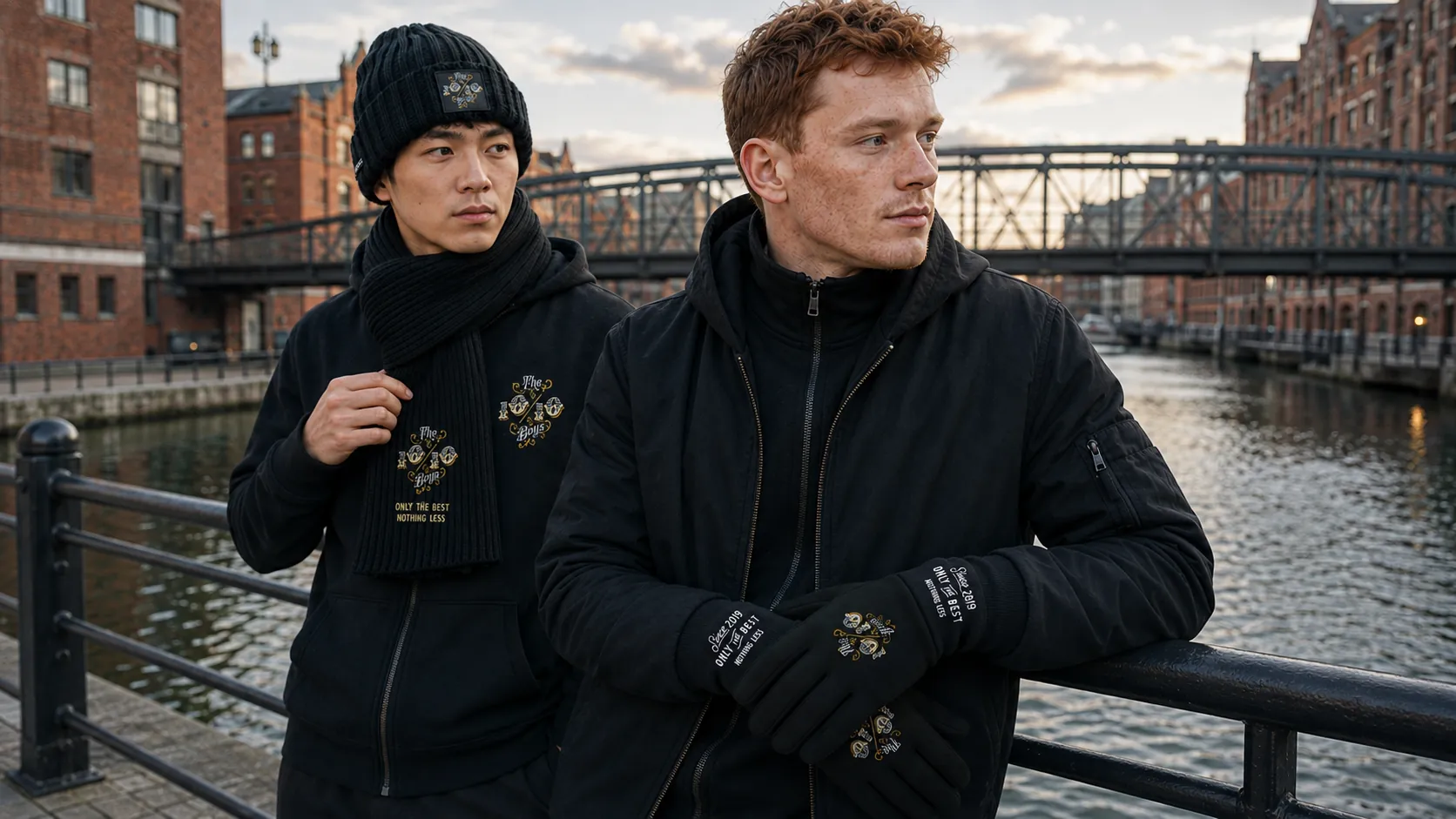
This is where cold-weather outfits get heavy, and it is a volume problem rather than a styling one. A beanie and a hood occupy the same space: worn together with the hood up, the head reads as one large mass and the neck disappears. Beanie on, hood down is the cleaner default, because the hood then sits across the shoulders, adding width where there is room instead of height where there is not.
Fit matters more than colour here. A beanie pulled low over a high collar compresses everything between jaw and shoulders; leave a gap and the silhouette breathes. A fold-up cuff controls how tall it sits.
Zip hoodies partner with a beanie more easily than pullovers, because the neckline opens: zipped up for a compact look, or half open so the layer underneath breaks the block of black. The hoodies and hats categories are where this pairing gets decided.
Adding a Scarf Without Overloading the Outfit
Wrapped close at the neck, a scarf works like a collar, filling the space between jaw and chest and pushing attention up to the face. Left long, it does the opposite, running two vertical lines down the body so the torso reads longer. The first suits a plain top; the second needs more room.
Watch for a scarf falling straight over a chest graphic: half the graphic disappears and both pieces lose. If the top carries the branding, wrap the scarf high. If the scarf carries it, keep the chest plain.
Texture is the other lever. A ribbed knit like the Scarf – Only The Best reads as a distinct surface even in a fully black outfit, adding interest without a second colour or a second logo.
Where Gloves Fit Into the Outfit
Gloves take up the least visual space of any winter accessory and still finish the line of the arm: a sleeve ending at a bare wrist stops abruptly, while one running into a glove reads as continuous. They are also the safest place to repeat a detail, because hands sit low in the frame, so a small branded mark echoes a badge on a beanie without becoming a third focal point.
Function still comes first. The Gloves – Only The Best are insulated with a soft inner lining and touchscreen-friendly fingertips, which matters: a pair you keep taking off ends up in a pocket, and an accessory in a pocket is not part of the outfit.
Colour Combinations That Stay Cohesive
Start from a neutral base. Black, charcoal, grey and off-white give every accessory something to sit against and let texture do the talking. Allow one accent, in one place: a colour appearing once reads as a choice, while the same colour on the beanie, the scarf and the gloves reads as a set, and sets look bought rather than built.
Repeat tones instead of matching them. A black beanie with a black scarf in a different knit looks intentional; the identical yarn across three pieces looks like a uniform. Treat branding the same way: one mark at full strength, everything else scaled down.
How Texture Changes a Cold-Weather Outfit
Ribbed surfaces catch light in lines, reading as highlights and shadows rather than a solid block. The Beanie Hat – Only The Best uses a classic thick rib for that reason. Knitted surfaces absorb light and look softer and slightly larger, useful at the neck and unhelpful anywhere already carrying volume. Smooth surfaces reflect and read as sharper. Structured pieces hold their own shape instead of draping, which keeps a layered fit from turning shapeless. Matte stays quiet, the background that lets one ribbed piece stand out.
Aim for two or three different surfaces in a fit, not one and not six.
A Cold-Weather Accessories Checklist
- Does each accessory have a clear purpose, practical or visual?
- Is one piece obviously the main focus?
- Is there too much volume stacked around the neck and hood?
- Do at least two pieces share a tone or a surface?
- Are two large logos competing for attention?
- Does every accessory still work once the outer layer goes on?
- Is the outfit comfortable enough to keep on for hours?
- Could you remove one item without losing warmth or shape?
If the answer to the last one is yes, remove it. That is usually the piece making the outfit look crowded.
Common Winter Streetwear Accessory Mistakes
- Too many statement pieces. Three branded items means three things asking to be looked at first.
- Repeating a large logo. The same mark at the same size in three places reads as packaging.
- Ignoring volume already in the fit. A hoodie under a jacket has used the space at the neck; a thick scarf on top is where outfits get bulky.
- Too many unrelated colours. More pieces means more chances to clash.
- Choosing impact over comfort. Anything you take off after an hour was a prop.
- Matching everything exactly. Full sets look coordinated in a photo and stiff in real life.
FAQs About Winter Streetwear Accessories
What accessories work best with winter streetwear?
A beanie, a scarf and gloves cover the three places heat is lost and the three places an outfit can be finished. A beanie frames the face, a scarf closes the neck and adds texture, and gloves complete the arm. Over a hoodie as the base layer, those three handle most cold-weather situations.
Can you wear a beanie with a hoodie?
Yes, and it is one of the most reliable cold-weather pairings. The thing to control is volume. With the hood down, a beanie sits cleanly and the hood adds width across the shoulders. With the hood up over a beanie, the head reads as one mass, so keep the rest plain.
How many accessories should a streetwear outfit have?
Two or three stays balanced in winter. One piece carries the visual weight and the others support it with function, a repeated tone or a different texture. Beyond three, pieces start overlapping in the same area of the body and the outfit reads crowded rather than layered.
How do men accessorise streetwear in cold weather?
Function first, then one focal point. Choose the accessory that solves the real problem that day, give it the strongest branding or texture, and keep everything else neutral. A dark base with one tone repeated across two pieces keeps a heavily layered fit looking deliberate.
Building a Balanced Winter Fit
Function decides what goes on, one piece carries the look, and proportion, colour and texture keep the rest in support. Get that order right and a beanie, a scarf, gloves and a hoodie stop being four decisions and start behaving like one outfit.
A full-zip hoody is the layer most winter fits are built on, and the accessories are what finish it. New fits and drops land first on Instagram and TikTok.